




What exactly is equine coaching in a professional setting?
Equine coaching is a distinctive development method that uses guided interactions with horses to build personal and professional skills. Because horses can't be persuaded, flattered, or talked round, they respond only to what a person is genuinely projecting — their posture, breathing, energy, and intent. That makes them unusually honest mirrors, helping participants observe and adjust their own behaviour, particularly around leadership, communication, and emotional management.
Why are horses effective in coaching programmes?
Horses are highly intuitive, highly sensitive animals that respond instantly to human energy and non-verbal signals — a raised shoulder, a held breath, a moment of hesitation. Because they have no stake in being polite or diplomatic, their reactions offer honest, immediate, and non-judgmental feedback, helping participants adjust their behaviour in a way that feels natural rather than forced.
What are the main benefits of equine coaching for teams and managers?
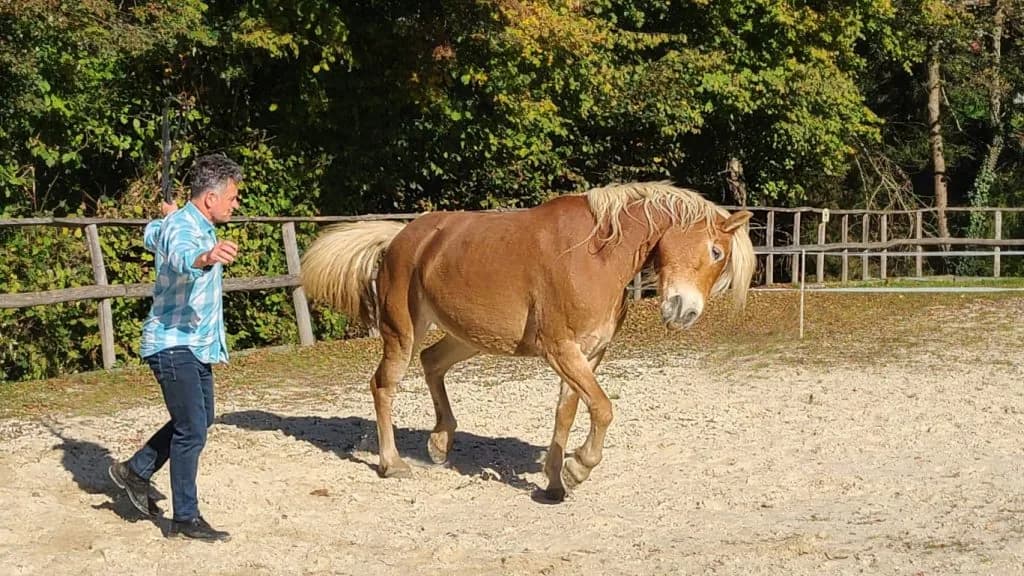
One of the main benefits of equine coaching is that it strengthens team cohesion by building trust and mutual understanding between team members. Through structured interactions with horses — leading one on a lead rope, working as a pair to guide a horse through an obstacle, or simply standing quietly near one — participants are encouraged to align their actions with their verbal and non-verbal cues, often noticing gaps between the two for the first time.
With our unique team coaching approach, we help you strengthen interpersonal skills by making people aware of their non-verbal cues and the energy they project — factors that play a crucial role in leadership development, and that are often invisible in a normal office setting.
Why Use Equine Coaching to Support Leadership Development?
Because it provides a distinctive and genuinely useful approach to leadership development. By interacting with horses, leaders build self-awareness and emotional intelligence in a way that few classroom exercises can match. Equine Coaching supports Leadership Development because horses mirror our behaviour, offering immediate feedback on our management style and creating an authentic, memorable learning experience that people tend to carry with them long after the session ends.
Understanding what it's all about
Equine coaching is an experiential learning modality where participants interact with horses to gain insight into their own behaviour and communication style. Unlike traditional coaching methods, which rely mainly on conversation, equine coaching leverages the horse's innate sensitivity to human emotions to provide immediate, physical feedback — a horse will step back from tension and lean toward calm, confident energy — creating a genuinely profound learning environment that words alone rarely produce.
A horse's reactions provide instant feedback, allowing for real-time learning and adjustment — there's no waiting for a performance review or a delayed piece of feedback weeks later. By interacting with horses, participants sharpen their emotional awareness, empathy, and self-regulation, often discovering habits of tension or over-control they hadn't noticed in themselves before.
Applications in the Workplace
Our sessions can be tailored to address a range of workplace challenges, from sharpening leadership skills to improving team dynamics or handling change more calmly. By unlocking the potential of emotional intelligence, we help you build a genuinely more effective working environment — one grounded in observed behaviour rather than theory alone.
Improving Leadership with Equine Coaching
Leadership in today's workplace calls for adaptability, empathy, and resilience. This is a distinctive opportunity to sharpen these essential skills through a hands-on, experiential learning platform that leaders rarely encounter elsewhere.
Developing Self-Awareness
Horses respond to a person's intentions and emotions, acting as mirrors that reflect a leader's emotional state back at them — often more accurately than a colleague would dare to. By recognising these reflections, leaders build greater self-awareness, an essential trait for influencing and directing others successfully. This heightened awareness encourages real introspection and personal growth, and tends to lead to a more authentic style of management long after the session is over.
Building Trust and Empathy
Engaging with horses means building a rapport based on trust and respect — a horse simply won't cooperate otherwise. Leaders who develop these qualities with horses often find they transfer surprisingly well to their interactions in the workplace, creating an environment where employees feel genuinely valued and heard. This trust helps build a more positive organisational culture, enhancing Team Cohesion through Equine Coaching.
Fostering Team Dynamics Through Equine Coaching
The success of any organisation rests heavily on the cooperation and synergy of its teams. Equine coaching acts as a catalyst for improving team dynamics, surfacing common interpersonal friction points and promoting a deeper mutual understanding between colleagues who may have worked together for years without really seeing how each other operates under pressure.
Encouraging Empathy and Understanding
By working together in a setting well outside their usual routine, team members gain real insight into each other's strengths and weaknesses. The horses' responses offer a non-judgmental perspective on how the group is actually functioning, promoting empathy and understanding among colleagues. These insights encourage the team to embrace its differences and make better use of each member's unique contribution, rather than smoothing them over.

Strengthening Team Cohesion
This approach often requires teams to solve problems collaboratively — guiding a horse around an obstacle, for instance, cannot be done by one person alone, however confident they are — which reinforces the importance of unity and cooperation. By working through these activities together, teams tend to develop stronger bonds, improving cohesiveness and efficiency once they're back in the workplace.
This article was written by Marc Prager.