

What Are the 4 DISC Personality Types?
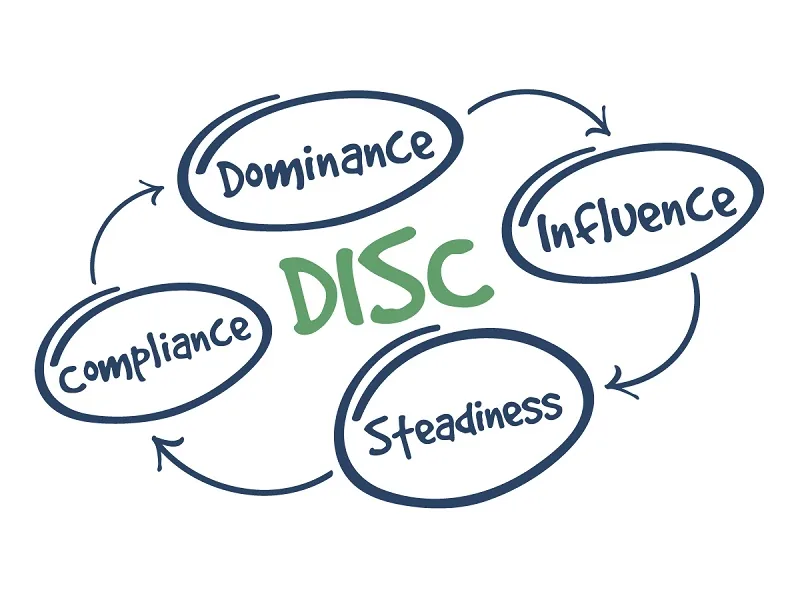
DISC is a four-letter shorthand for four major personality types — Dominance (D), Influence (I), Steadiness (S), and Conscientiousness (C). These traits set people apart and shape how each of them reads a situation. Curious where you fit? Take our DISC Assessment — it doesn't measure intelligence, only your dominant behavioural style.
Who Created the DISC Model?
William Moulton Marston is considered the father of the DISC model, having spent a lifetime studying human nature and emotional response. Our natural personalities shape the people around us in every daily interaction. Marston's book “Emotions of Normal People” (1928) was the first to set out the DISC personality model. Walter V. Clark later built the first DISC personality test in the 1950s for corporate personnel selection — a method called Activity Vector Analysis.
When to Use DISC Profiles in Business?
In our consulting practice, we find DISC profiles invaluable for both team building and individual coaching. Knowing whether someone is Dominant, Influential, Steady, or Conscientious lets us tailor communication and conflict-resolution strategies far more effectively.
For teams, this understanding builds a collaborative environment where diverse strengths are put to work, lifting productivity and morale. In individual coaching, DISC pinpoints personal growth areas and shows how each person can best contribute to the team's goals — a personalised approach that sharpens individual performance.
What Is the Most Common DISC Personality?
According to the DISC validation study, Steadiness (S) is the most common DISC personality type, found in almost 32% of the world's population. People with this profile tend to become natural mentors, with influence and motivation among their greatest strengths.
They're trustworthy and always ready to listen to the people around them at work. Within an organisation, they're often the ones holding business stability together — though they can be slower to adapt to change and tend to resist it until it becomes necessary.
Which Personality Trait Does Each DISC Quadrant Exhibit?
The four-quadrant model highlights different traits in a person — useful for your career as much as your personal growth. Each quadrant carries characteristics that describe it best:
- Dominance: confident, outgoing, and result-oriented.
- Influence: optimistic, polite, and trustworthy.
- Steadiness: calm, deliberate, and warm.
- Conscientiousness: accurate, analytical, and systematic.
What Is the Rarest DISC Profile?
The rarest DISC profile is D (Dominance), making up only 9% of the global population. These individuals tend to be blunt, decisive, and strong-willed, with a firm sense of their own will and a readiness to argue their decisions. Well-known figures with type D personalities include Hillary Clinton, Margaret Thatcher, Robert De Niro, and Michael Jordan.
What Is the Best DISC Profile For a Leader?
There is no single “best” DISC profile for a manager. Dominance, Influence, Steadiness, and Conscientiousness each bring different strengths and approaches to leadership. A high-D might excel at decisiveness, a high-I at communication and relationship-building, Steadiness at keeping the team stable, and Conscientiousness at meticulous attention to detail. Effective management depends on context, team composition, and organisational needs — versatility and adaptability matter more than any fixed archetype.
Why DISC Personality Assessment Matters for Organisations
The four DISC traits combine in different proportions to produce twelve distinct behavioural styles. When working with people from a wide range of backgrounds, the DISC profile offers the fairest way to assess everyone on the same scale.
Today it's standard practice for recruiters to have every candidate complete the online test before hiring. A DISC assessment runs through a series of questions that each person answers for themselves, and the resulting report reveals their dominant behavioural style.
Businesses and organisations use this self-assessment tool to identify their employees' strengths and weaknesses. Within teams, differing aptitudes can make group communication difficult — so in a leadership role, it's essential to assign tasks that play to each person's natural style, setting the bar high and getting the best out of the time available.
Identifying each team member's traits makes you a more effective manager and team leader. You need to understand where your employees stand before you can train them, and a DISC assessment gives you exactly the information required — without making anyone feel judged.
How Can the DISC Profile Help You?
A DISC profile helps you spot your strengths and limits based on your personality style. In turn, you gain awareness of your natural communication preferences and your ability to handle challenging situations. Beyond conflict handling and negotiation, it also shows you how to strengthen your relationships with peers.
Different personality traits carry their own benefits and, used well, help put people in the roles that lift their careers. Self-awareness is essential for better collaboration, stronger teamwork, and closer relationships. Understanding your own personality traits is the single most important step toward making the most of any business you take on. A sports captain, for instance, needs to know their team's and opponents' strengths and weaknesses to win the match; in customer service, you need to know your customer well to turn them into a loyal client.
FAQ
What Are the Four Main DISC Personality Types and Their Characteristics?
The four DISC classifications are Dominance (D), marked by assertiveness, strong will, and a focus on results, with a direct, competitive style that shapes how these people communicate. Influence (I) stands out for its positivity, enthusiasm, and sociability, building relationships and motivating others in ways that enrich teamwork. Steadiness (S) brings patience, dependability, and a preference for consistency, prioritising team unity and systematic approaches that keep interactions running smoothly. Conscientiousness (C) reflects accuracy, logical reasoning, and a commitment to quality, with close attention to detail and high standards that translate into an organised way of working. Each of these DISC types carries its own drivers, anxieties, and working methods, shaping how they communicate and lead — and understanding them can dramatically improve how an organisation functions.
How Can the DISC Assessment Improve Communication Styles Within a Team?
The DISC assessment sharpens communication by letting team members adjust their approach to match their own personality traits and those of their audience. Once you know the different profiles, you can be direct and results-focused with D types, enthusiastic and relational with I types, calm and supportive with S types, and thorough and organised with C types. This adaptability cuts down on misunderstandings by recognising just how differently people prefer to communicate. Teams learn to read each personality's stress signals and engagement cues, leading to more effective, more compassionate interactions that respect everyone's natural style — and, in turn, stronger leadership and a more unified, efficient workplace.
How Does Understanding DISC Personality Profiles Help in Leadership Development?
Understanding DISC profiles sharpens leadership development by revealing a leader's natural tendencies and blind spots. It helps leaders recognise whether they lean toward an authoritative (D), inspirational (I), participative (S), or analytical (C) style, and then build the flexibility to adopt other approaches when the situation calls for it. Leaders learn to spot their own biases in recruitment, delegation, and recognition, so they stop unconsciously favouring profiles like their own. This awareness also supports personal stress management and adapting to team members' different motivational needs — ultimately building more inclusive, effective leadership that brings out the best in every personality.
In What Scenarios Do Personality Types Tend to Clash in a Work Environment Based on the DISC Assessment?
Conflict often flares when D types push through rapid change without consulting S types, who need time and security to adapt. I types can frustrate C types with a lack of documentary rigour and a habit of running with ideas before they're fully validated. C types, in turn, can stall D types by demanding exhaustive analysis when a quick decision is needed. S types can feel overwhelmed by I types constantly chasing new interactions. Tension also builds around pace (fast versus reflective), risk appetite (bold versus cautious), and priorities (tasks versus relationships) — especially when people don't recognise these as legitimate, alternative ways of working.
How Can You Identify Your Own DISC Personality Type Through Free Assessments?
To find your DISC personality type for free, look for reliable online assessments from professional development sites or HR platforms. These typically run 12 to 28 questions, asking you to pick the behaviours or adjectives that best match your communication style at work. Answer instinctively rather than overthinking it, to get an authentic result. You'll then receive a profile scoring you across the four DISC dimensions — Dominance, Influence, Steadiness, and Conscientiousness — along with detailed descriptions. For a fuller picture, combine several free tests and reflect on real situations where these styles show up naturally in you. It's also worth asking colleagues for their perspective on your typical behaviour and how it shapes team dynamics and leadership within your organisation.
What Is the Importance of Recognizing Different Communication Styles Among Various DISC Personality Types?
Recognising the different communication styles across DISC types matters because it heads off misinterpretation and workplace friction. When team members understand that D types want brief, outcome-focused communication, I types value enthusiastic, collaborative dialogue, S types appreciate patient, supportive exchanges, and C types need detailed, logical information, they can adjust their approach accordingly. This turns what might look like rudeness, superficiality, indecision, or coldness into an understood behavioural preference — enabling more productive conversations, less frustration, and an environment where everyone feels heard. The payoff: stronger relationships and more efficient collaboration across every personality type.
Other Articles on DISC Assessment
- C Type Personality & DISC
- D Type Personality & DISC
- DISC Communication Exercises: Activities For Each Style
- DISC Online Training
- DISC Personality Profile
- DISC Personality Test: be a Cut Above the Rest by Discovering yourself
- DISC Profiles: All Personality Types Explained
- DISC Team Building Exercises: Activities to Strengthen Relationships
- DISC Training Activities: A Guide on How to Interact Better
- History of DISC: Evolution of DISC Personality Styles
- How DISC Works: What You Need to Know About DISC
- I Type Personality with DISC
- Videos on DISC personality test
This article was written by Marc Prager.